

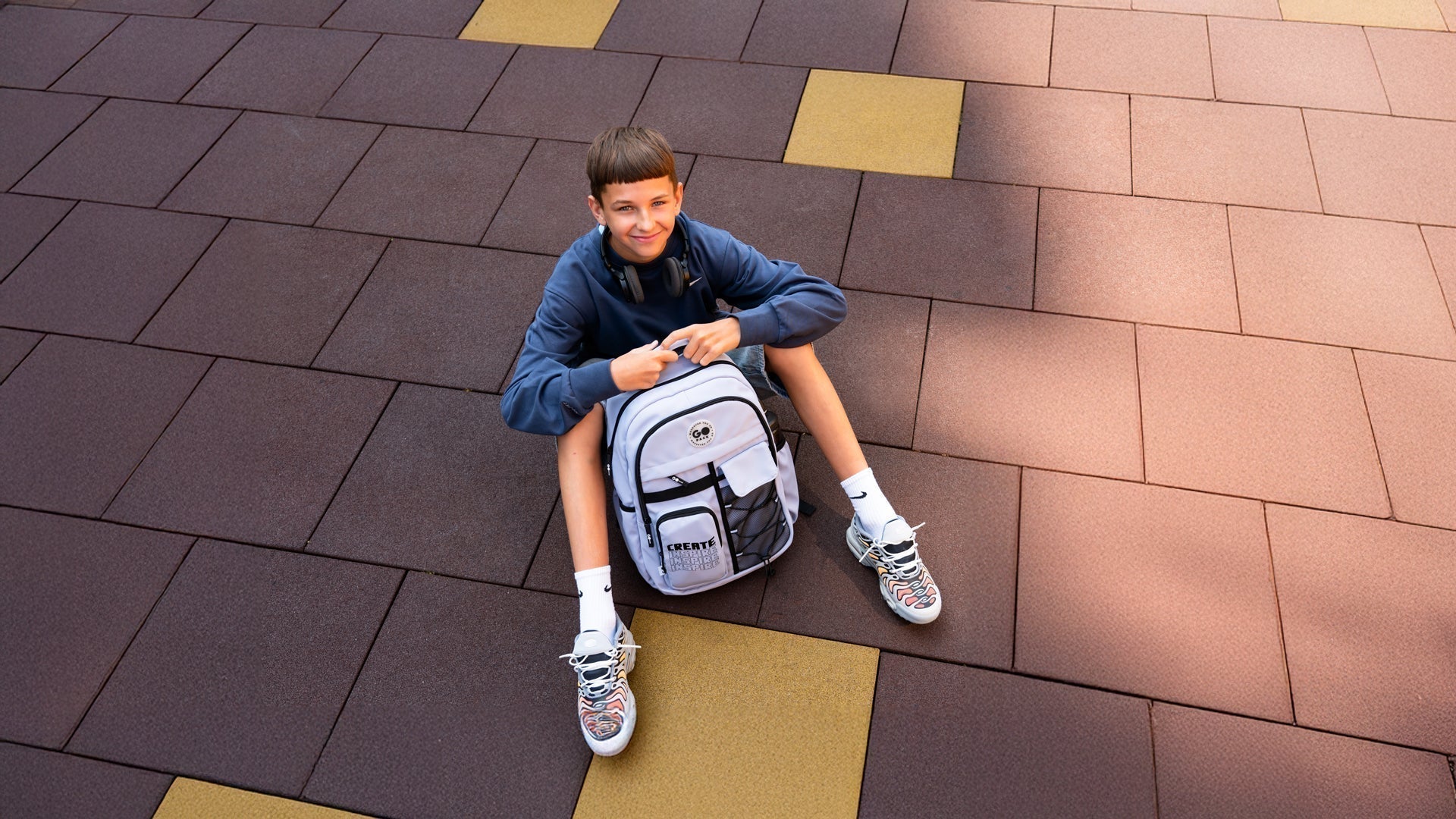
A teenager's preparations for school often resemble a trial: "Where's my notebook?", "I can't find my charger!", "Where's my sports uniform?". And at some point, you might catch yourself thinking: I'm not just a mom – I'm a dispatcher, bearing the brunt of all this hustle and bustle. But there's an opportunity to gradually embark on a path of order and organization. We'll tell you how to help a student take the conductor's baton and independently tame the disarray of their affairs. And gradually, using interaction with accessories as an example, solidify this as a useful habit.
When we talk about a lack of discipline, we often mean something entirely different: it's hard for a teenager to keep dozens of small things in mind every day. At this age, attention is already working overtime – studies, social life, emotions, bodily changes. Therefore, habits are best formed not by "strengthening willpower," but by intelligently organizing daily life.

Give your child the right to make independent choices
Adolescence is a time when a child learns to be an autonomous individual. And this is most noticeable in small things: "I want this specific color," "I like this print," "I won't wear what was chosen without me." For parents, this might sound like a whim, but in reality, "their own" is an important psychological need. Owning things gives a teenager a sense of: I influence my life.
GoPack backpack – the first step to solidifying the habit of organizing your space
It's with the child every day and always visible. It enhances their style and fulfills practical needs: it's where their studies, plans, and necessary items are concentrated. When a teenager feels the backpack is theirs, they use it more consciously – which means responsibility for their own belongings is formed more easily.

Things as triggers: why "system" works better than willpower
In everyday life, we rely on environmental cues: "saw it – remembered it – did it." This is a normal mechanism that reduces the burden on memory. Teenagers especially need this: when there's a lot going on in their heads, the worst thing is to also have to keep track of "where everything is" and "did I take everything." So, if a backpack has a clear logic, preparing for tomorrow becomes a simple automatic action.
What habits are reinforced by a well-chosen backpack
- Packing the night before. When things have their places, it's easier for a teenager to quickly check for completeness: notebooks, pencil case, small items.
- Maintaining order on an ongoing basis. Order is not perfect cleanliness, but minimal clutter. When there are compartments for small items and a separate place for things that need to stay flat (papers, notebooks), items don't turn into a complete jumble.
- Fewer lost items. Lost keys, cards, headphones are often not due to inattention, but due to the lack of a permanent "home" for these items. If there's a specially designated place, a lion's share of daily hustle and bustle disappears.
- Punctuality and calm. When everything needed can be found quickly, the teenager is less likely to be late.
- Independence. Most importantly: a backpack that is liked and convenient to use becomes an ally for the teenager, someone they can rely on.

Why "any old" backpack doesn't have this effect
Firstly, if the backpack isn't aesthetically pleasing, it won't become a favorite – the teenager will use it formally. Secondly, an uncomfortable fit, heavy or slippery straps, and jammed zippers turn daily carrying into an irritant – and there will be no motivation to maintain order. Thirdly, without thoughtful internal organization, automatism doesn't arise: every day you have to pack everything anew and conduct real excavations to find a pen at the bottom of the backpack.

How to choose a teenage backpack
A simple 70/30 formula works: 70% – the teenager's choice (style, color, print or understated design), 30% – parents' criteria (comfort, durability, logic of compartments).
Ask your teenager:
- What do you carry every day?
- What needs to be within reach in 3 seconds?
- Where do you actually carry it (school/city/clubs)?
- What style do you choose most often and wear every day?
And parents should check this checklist:
- does it sit comfortably on the back, are the straps wide and anatomical;
- are the zippers and seams of high quality;
- is there convenient internal organization for various small items;
- does the volume meet actual needs.

Here it is important to find a proven guide. Brands that specialize specifically in teenage backpacks – for example, GoPack – usually balance design (from restrained models to bright prints) and practicality to ensure the backpack supports the daily rhythm. And well-designed accessories for a teenager are a way to express their own autonomy and have support in daily affairs. And GoPack is always there, wherever you go.
GoPack: Wherever you go. Whenever you go


